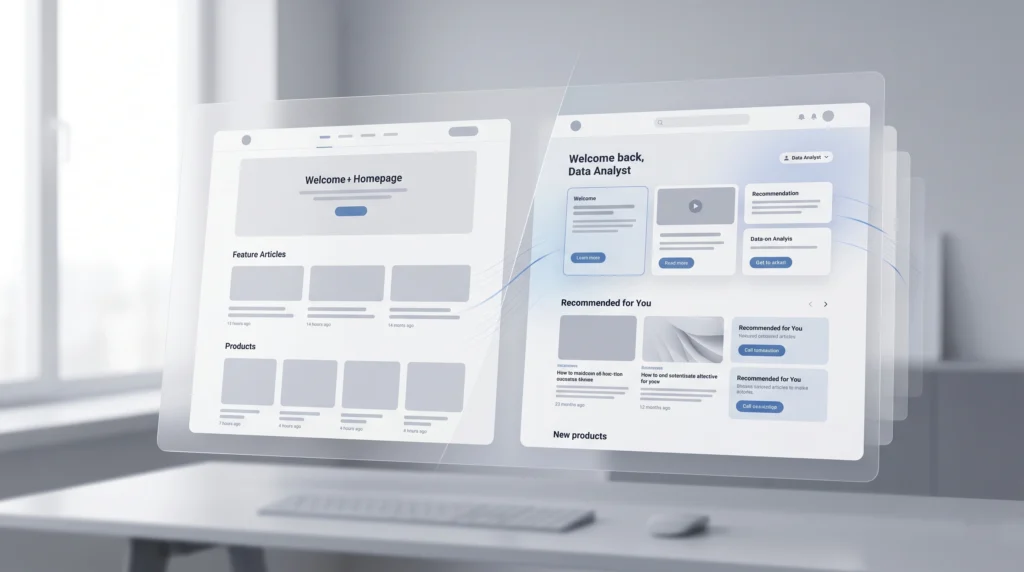
Websites used to be static. You built them, polished them, launched them, and hoped they stayed relevant for a while. That worked when user expectations were low and competition was slower.
Now people expect websites to behave differently. They don’t want to dig through pages or figure things out on their own. They want answers, suggestions, and guidance in real time. And that shift is exactly where AI starts changing the entire idea of user experience.
An AI-powered website is not just a site with a chatbot slapped on it. That’s the lazy version most people are building right now. Real AI integration goes deeper. It changes how the website responds to users, how it adapts, and how it helps people move from confusion to clarity without friction.
Instead of forcing every visitor through the same fixed path, AI allows the experience to adjust. A returning user might see different suggestions than a first-time visitor. Someone exploring services might get guided content instead of generic pages. Someone ready to buy doesn’t have to scroll through unnecessary information before reaching action points.
The biggest change here is expectation. Users are starting to assume that websites understand them. Not in a creepy way, but in a practical sense. They expect relevance. They expect speed. They expect less effort.
This is where traditional UX design starts to evolve. It’s no longer just about layout, spacing, and navigation. It becomes about decision systems. What should this user see next? What information actually helps them right now? What can be removed so they reach value faster?
AI helps answer those questions dynamically instead of relying on one fixed structure for everyone.
Another important shift is support. AI-powered websites don’t wait for users to find a contact page. They can answer questions in context, explain services, and reduce confusion before it turns into abandonment. That alone changes conversion rates in a very direct way.
But there’s also a mistake happening in the industry. A lot of businesses think adding AI means adding complexity. The opposite is usually true. Good AI integration should make a website feel simpler, not heavier. If users feel like they need to “figure out” how to use the AI feature, it has already failed.
The best implementations feel invisible. The website just feels more helpful. More aware. Less frustrating.
We’re still early in this shift, which means most websites today are built for yesterday’s user behavior. But expectations are changing fast. The gap between “standard websites” and “adaptive AI-driven experiences” is going to become very obvious over the next few years.
At that point, the question won’t be whether AI should be part of a website.
It will be why it wasn’t there sooner.