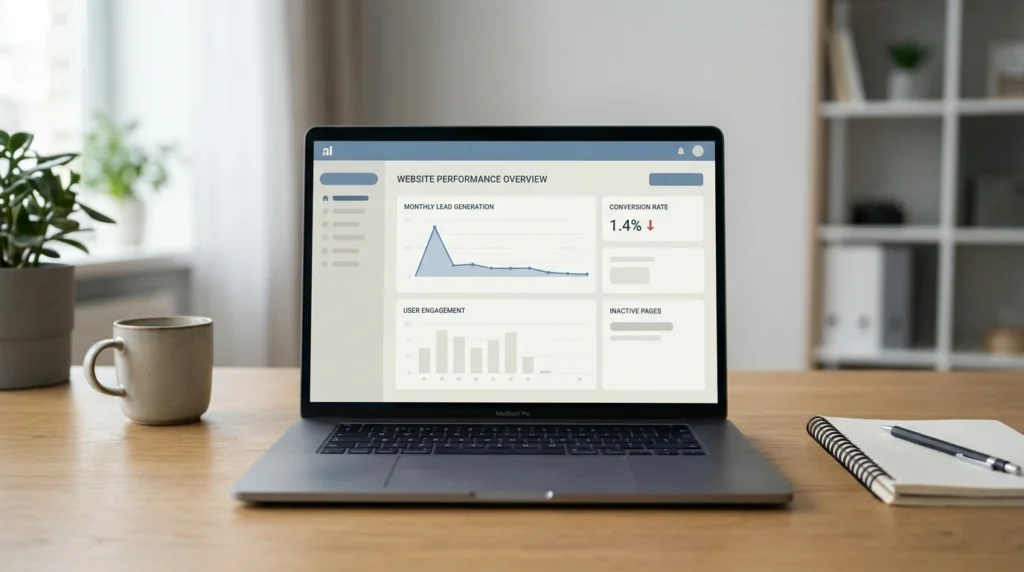
Your website is getting visitors. People are clicking your ads, finding you through Google, or discovering your business through social media. Yet the inquiries aren’t coming in. No calls. No form submissions. No sales.
The uncomfortable truth is that having a website in 2026 is no longer enough. Almost every business has one. The difference is that some websites work as sales tools, while others function as expensive digital brochures collecting dust on the internet.
If your website isn’t generating leads, there’s usually a reason.
Your Website Looks Good, But It Doesn’t Build Trust
Many business owners assume a clean design is all they need. It isn’t.
Visitors decide within seconds whether they trust your business. They’re subconsciously asking themselves: Can I trust this company? Do they know what they’re doing? Are they better than the alternatives?
If your website lacks client testimonials, case studies, recent projects, reviews, certifications, or clear information about your business, visitors will hesitate. And hesitation kills conversions. Trust isn’t built by claiming you’re the best. It’s built by proving it.
You’re Talking About Yourself Instead of Your Customers
A surprising number of business websites spend most of their homepage talking about the company.
“We are passionate.”
“We are innovative.”
“We are committed to excellence.”
The problem is that every competitor is saying the exact same thing. Your visitors aren’t looking for a company biography. They’re looking for solutions. They want to know how you can help them, what problems you solve, and why they should choose you. The best websites focus on the customer’s needs first and introduce the company as the answer.
Your Website Is Too Slow
Speed has become one of the most important factors affecting user experience. If your website takes too long to load, visitors leave before they even see what you offer.
A slow website doesn’t just frustrate users. It can reduce conversions, hurt your search engine rankings, and create a poor impression of your business. Every second matters. In a world where people expect instant access to information, performance is no longer optional.
Your Call-to-Action Isn’t Clear
Imagine walking into a store, looking around, and having nobody tell you where to go or what to do next. That’s exactly what happens on many business websites.
After viewing your services, visitors should immediately understand the next step. Whether it’s requesting a quote, booking a consultation, scheduling a demo, or contacting your team, the path should be obvious.
If visitors have to think about what action to take, many simply won’t take one.
You’re Ignoring Mobile Users
Most website traffic now comes from mobile devices, yet many websites are still designed primarily for desktop screens.
Small text, difficult navigation, slow loading times, broken layouts, and frustrating forms create a poor mobile experience. Even if your desktop site looks great, a weak mobile experience can drive away a significant percentage of potential customers.
A website that isn’t optimized for mobile is leaving money on the table.
Your Business Doesn’t Stand Out
Try this simple exercise. Hide your logo and company name from your homepage.
Could it belong to any of your competitors?
Many businesses rely on generic messaging like “high-quality service,” “professional team,” or “customer satisfaction.” While these claims may be true, they don’t make your business memorable.
Your website should clearly communicate what makes you different. Whether it’s your expertise, process, turnaround time, customer experience, or unique approach, visitors should immediately understand why they should choose you instead of someone else.
You’re Attracting the Wrong Traffic
Sometimes the issue isn’t the website itself. It’s the audience arriving on it.
A thousand visitors who aren’t interested in your services are worth far less than ten visitors actively searching for what you offer. Many businesses focus entirely on increasing traffic while ignoring traffic quality.
The goal isn’t simply to get more visitors. The goal is to attract the right visitors. Strong SEO, targeted advertising, and strategic content help bring qualified prospects to your website instead of random traffic.
You’re Treating Your Website Like a Finished Project
One of the biggest mistakes businesses make is launching a website and never updating it again.
The internet changes constantly. Search engines evolve, customer expectations shift, and competitors improve. A website that performed well two years ago may already be falling behind.
Successful businesses continuously improve their websites by updating content, refining user experience, testing conversion paths, analyzing visitor behavior, and making data-driven improvements.
Your website isn’t a one-time project. It’s an ongoing business asset.
Final Thoughts
If your website isn’t generating leads in 2026, the problem usually isn’t a lack of visitors. More often, it’s a lack of trust, clarity, differentiation, performance, or conversion strategy.
A successful website isn’t the one that looks the most impressive. It’s the one that turns visitors into customers.
At Blackwing, we believe websites should do more than exist online. They should actively contribute to business growth. Every design decision, every page, and every interaction should move visitors one step closer to becoming customers.
Because at the end of the day, a website that doesn’t generate leads is just an expensive decoration on the internet.